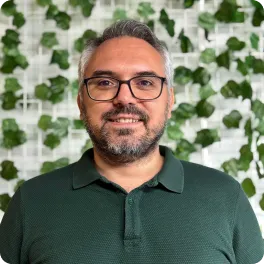
Poland wasn't just another stop on the calendar. It was a deliberate choice, and a week that confirmed what we had been sensing from conversations with engineering leaders across Europe: the questions being asked in Warsaw are the same questions keeping CTOs and Heads of Engineering awake everywhere else.
Fair warning: our Polish vocabulary was very limited. But saying "Dzień dobry!" with a smile all day turned out to be a genuinely great icebreaker, and honestly, a great experience in itself. Warsaw met us warmly, and we tried to return the energy.
We spent April 20-26 across Warsaw, moving between summits, community meetups, and company offices. Here's what that week looked like, and what it meant for us.
The Week at a Glance

The agenda was packed but intentional. We designed the week around three distinct audiences: business and technology executives, engineering leaders and architects, and DevOps and platform engineers. Each event brought a different conversation, and together they painted a vivid picture of where the Polish engineering ecosystem is heading.
Between sessions, Warsaw fed us well. If you haven't had pierogi fresh from a milk bar, you're missing something, and it turns out a plate of ruskie at lunch is surprisingly good fuel for an afternoon of back-to-back conversations about engineering metrics.
April 21: Data & AI Warsaw Tech Summit

The day started early at the Legia Warszawa Conference Center. The room was filled with data engineers, AI practitioners, and product leaders: people who are actively building with AI, not just talking about it.
Omer took the stage together with our Poland partner Andrzej to deliver "The Impact of AI on Developer Productivity and Engineering Culture." The talk tackled something the industry keeps dancing around: the difference between being fast and being productive. AI coding tools like Copilot and Cursor are genuinely accelerating output, but output alone isn't the full picture. The harder question is whether teams are delivering better outcomes, and whether the measurement frameworks organizations are using are actually fit for that question.
The response from the audience was striking. The moment the conversation shifted from tools to trust, specifically how measurement can erode engineering culture if done wrong, the energy in the room changed. This isn't a Polish problem. It's a universal one.
April 22: IDC CIO Summit Poland
The IDC CIO Summit brought together a different kind of audience: CIOs, CTOs, and senior IT executives responsible for technology strategy at a business level. The conversations here were less about tooling and more about accountability: how do you turn technology investments into outcomes that the board can actually see?

Şükrü's talk, "Turning CIO Challenges into Measurable Outcomes with Oobeya," spoke directly to that pressure. The core argument: visibility is the missing layer between strategy and execution. Most organizations have data. They have Jira, they have CI/CD pipelines, they have quality tools, but they don't have a coherent view across all of it. The result is leadership making decisions on intuition where they should have clarity.
What stood out in the post-talk conversations was how many CIOs were dealing with the same tension: pressure to adopt AI rapidly, combined with a growing anxiety that they couldn't actually measure whether it was working.
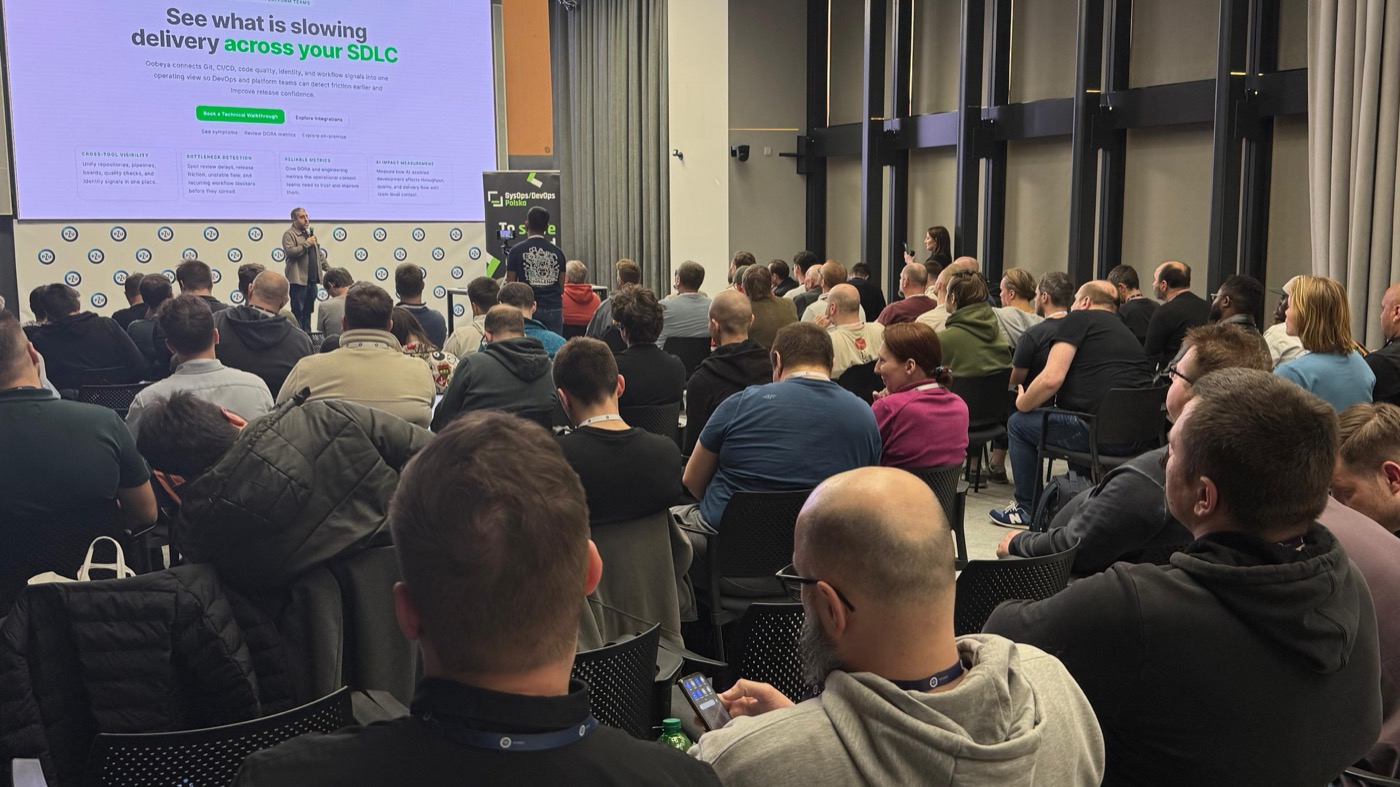
April 23: SysOps/DevOps Warszawa MeetUp #84

Thursday evening felt different, in the best way. The SysOps/DevOps Warszawa MeetUp is a grassroots community event, and the energy at PZU on Rondo Daszyńskiego reflected that. These were engineers who build and run systems day-to-day, and they have no patience for abstractions that don't connect to real problems.
Emre's talk, "The SDLC Visibility Problem No One Talks About," drew directly from his own experience as a DevOps engineer in a large-scale organization. The story he shared, of a bottleneck that was solved through automation, only for a new, invisible bottleneck to emerge in its place, landed immediately with the audience.
The visibility problem isn't new. But as AI accelerates development cycles and distributes work across more tools and agents, the problem compounds. That's what made the conversation feel urgent rather than theoretical.
Emre also wrote a full piece expanding on the talk's core thesis, why visibility, not tools, is the real competitive advantage for engineering teams today, published on SysOps Polska: Nowy Stack DevOps: Dlaczego widoczność, a nie narzędzia, jest Twoją przewagą konkurencyjną
The 1:1 Meetings: Where the Real Conversations Happen
Beyond the stages and panel sessions, the on-site meetings on April 20, 23, and 24 were arguably the most valuable part of the week. We visited companies directly, ran live demos, and sat down with engineering leaders in their own environments.
One visit deserves a special mention: Microsoft Poland. We had the opportunity to sit down with their Poland and EMEA Go-to-Market leaders for a productive discussion, the kind of conversation that opens doors. Thank you to the Microsoft Poland team for the warm hospitality.

These conversations are always more honest than conference hallways. When you're in someone's office, looking at their actual setup and their actual challenges, the conversation gets specific fast. We heard about visibility gaps, about AI adoption anxiety, about teams that feel productive but can't demonstrate it upward.
The 1:1 sessions also gave us the perfect opportunity to show something we haven't announced publicly yet: Oobeya AI Chat. Seeing engineering leaders interact with it live, asking real questions about their own delivery data and getting instant, contextual answers, was one of the highlights of the week. More on that announcement soon.
How We Were Received
Honestly? Warmly, and with substance.
Poland's engineering ecosystem is not a market that's just getting started. It's mature, technically sophisticated, and keenly aware of what's happening at the frontier of software development. The questions we fielded across the week weren't surface-level. They were about governance, about compliance, about how to maintain engineering quality when the pace of delivery is increasing and the tools themselves are changing the nature of the work.
There's something about Warsaw that makes conversations feel grounded. Maybe it's the city itself, the mix of old and new. Or maybe it was just that the engineering community there is genuinely curious and direct. Either way, it felt like a place where real conversations happen.
Our local partner, PolDynamic, was instrumental in making the week work. Their knowledge of the local ecosystem, who to connect with and how to frame conversations, added real depth to every interaction.
What We Saw
A few themes emerged consistently across all three events and the private meetings:
AI adoption is happening, but measurement is lagging. Teams are using AI coding tools. The tools are changing workflows. But the frameworks organizations use to understand the impact, on quality, on delivery, on culture, haven't caught up.
The visibility problem is getting harder, not easier. More automation means more abstraction. More tools means more data silos. Engineering leaders are increasingly unable to answer basic questions about what's happening inside their delivery systems, not because the data doesn't exist, but because it's fragmented.
Trust is the real currency. Whether we were talking to a CIO about executive dashboards or to a DevOps engineer about pipeline metrics, the conversation kept returning to trust. Metrics only work when teams believe they're being used to understand and improve, not to surveil and judge.
What's Next
Poland was a beginning, not a one-time event. We left with a list of follow-up conversations, new relationships, and a clearer sense of how Oobeya's approach to engineering visibility resonates in the Central European market.
We're continuing the Engineering Visibility & AI Impact conversation in the coming months. If you weren't able to meet us in Warsaw and want to continue the dialogue, we'd be glad to connect.
Thank You
To everyone who joined us at the Data & AI Warsaw Tech Summit, the IDC CIO Summit, and SysOps/DevOps Warszawa MeetUp #84: thank you for the conversations, the questions, and the candor.
To the teams who opened their offices for our on-site visits: we don't take that lightly. Those conversations were among the most valuable of the entire week.
And to our friends at PolDynamic, this week wouldn't have been what it was without you.
We came with limited Polish and left with a lot of new connections, a clearer sense of where the market is heading, and an appreciation for pierogi that we didn't have before. Poland, we'll be back.
Dziękujemy!
Interested in continuing the conversation?
Schedule a demo with the Oobeya teamContinue Exploring
Written by Emre Dundar
Emre Dundar is the Co-Founder & Chief Product Officer of Oobeya. Before starting Oobeya, he worked as a DevOps and Release Manager at Isbank and Ericsson. He later transitioned to consulting, focusing on SDLC, DevOps, and code quality. Since 2018, he has been dedicated to building Oobeya, helping engineering leaders improve productivity and quality.